
Every managing partner I talk to describes the same day in different words. She is the one who has to make every decision, because if she doesn't, nothing moves. Her brain has to be "on" 24 hours a day. She's already running Clio or a comparable practice management system, and she's still drowning. That is not a technology problem in the sense most legal tech vendors mean it. It is a decision-making problem, and decision-making problems don't get solved by software that only tracks what already happened.
What practice management software actually does
Billing, time tracking, document storage, conflict checks, contact capture, invoicing — these are real tools that do real work. But look closely at what they have in common: every one of them fires after a decision has already been made. Something happened, and the software records it. None of them tell you, before you sign a client, whether that case will actually be profitable. None of them flag a client's communication pattern as one that historically turns into a collections problem. None of them route a new matter to the associate who handles that exact fact pattern fastest, based on how your firm has actually performed over the last several years.
The three problems no off-the-shelf tool touches
Strip away the jargon and three problems show up over and over in firms doing $1M or more in annual revenue, one to fifty attorneys, personal injury and corporate and litigation practices especially.
- Decision-making overload — the managing partner is the bottleneck for every meaningful call the firm makes, because nothing in the tech stack is built to make decisions, only to log them.
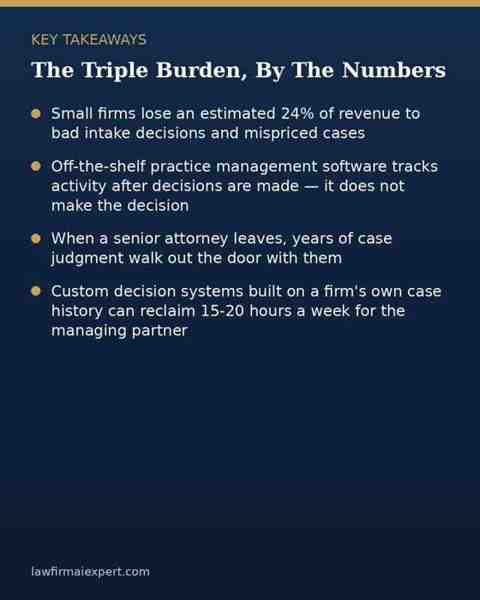
- Bad case selection and mispricing — research on small-firm operations puts the revenue lost to poor intake decisions and wrong pricing at roughly 24 percent. A case that "usually takes 45 hours, not 25" looks identical to a generic intake form.
- Knowledge that lives in one head — which judge prefers short briefs, which opposing counsel responds to which strategy, which associate is fastest at which task. When a senior attorney leaves, that judgment walks out the door, because no folder structure ever captured it.
What changes when the system makes the call
The fix isn't more dashboards. It's building custom decision systems on top of a firm's own case history — data the firm already has, sitting unused. A scoring model trained on the last three to five years of your matters can flag a case's likely profitability at intake, not six months in. A communication-pattern model can surface which new clients resemble past clients who became payment problems, before the retainer is signed. A knowledge-capture system can make a managing partner's judgment calls available to the whole team, so the team stops waiting on her for every decision.
“I don't just understand the business problem. I understand the life — running the firm, delivering the legal work, and being the one everyone else waits on, all at the same time.”
— Richard Schreiber, Founder, Law Firm AI Expert
That distinction matters because the math is straightforward. Reclaim 15 to 20 hours a week for a managing partner billing at $300 an hour, and you've freed up $6,000 a week — roughly $24,000 a month — in capacity that was previously spent on decisions a system can now make faster and more consistently than a single exhausted person working alone. Whether that time goes back into billable work, business development, or simply having a life outside the firm, it's the firm's time to spend again instead of the bottleneck's.
Where this fits with Law Firm AI Expert
This is the work Law Firm AI Expert does: not selling another piece of software to sit next to Clio, but building the decision layer that generic software was never designed to provide — case viability scoring, workflow intelligence, pricing optimization, and institutional memory capture, deployed with the same governance and security discipline you'd expect from a partner who takes AI risk as seriously as you do. It starts with a 30-day assessment that identifies the single biggest bottleneck in your firm and deploys one working solution against it, so you're not waiting months to see whether this actually changes anything.