The personal injury AI market has a clear leader, and the numbers aren't close. EvenUp has raised a $150 million Series E, brought total funding above $200 million, and now serves more than 1,500 personal injury firms with a platform that covers intake through resolution — case review, treatment monitoring, demand letter drafting, negotiation support, litigation documents, and executive analytics, all integrated with the case management systems firms already run.
Against that, a seed-stage tool trying to out-feature the incumbent is not a fight worth having. That's the honest starting point for TrialLift, the AI trial-preparation platform we're adding to the Law Firm AI Expert line of solutions — and it's exactly why TrialLift isn't built to compete with EvenUp on scope. It's built to solve the problem EvenUp and every other generative legal AI tool leaves standing: how do you actually know the AI got it right?
The gap nobody with scale has closed
AI-hallucinated citations in court filings are no longer a hypothetical risk — they're a documented, growing pattern of sanctions and reputational damage across the profession. Every platform racing to draft demand letters, briefs, and discovery responses faster is, by definition, producing more AI-generated legal text that someone has to verify before it goes in front of a judge. Almost none of them are built to prove that verification happened.
What the Citation Analyzer actually checks
TrialLift's Citation Analyzer is built on a retrieval-first architecture: it never treats a language model as the authority for whether something is true. Every check is tied back to direct retrieval from an authoritative source, across four dimensions.
- Quote fidelity — confirming quoted text matches the source exactly, not approximately.
- Pin-cite accuracy — verifying a citation points to the correct page and paragraph, not just the right case.
- Jurisdictional fit — determining whether the authority is binding or merely persuasive where the case is being filed.
- Subsequent history — checking whether the case has since been overturned, questioned, or distinguished.
A two-person lock, and a governance layer built for court
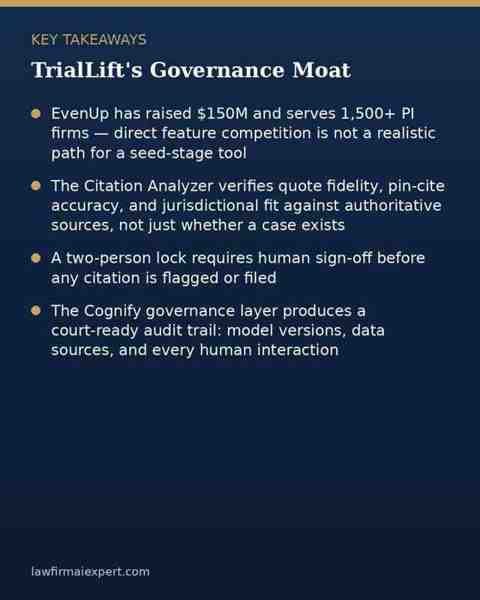
Every flagged citation runs through a two-person lock before it moves — a deliberate check against exactly the kind of overreliance that produces sanctions in the first place. Sitting underneath the Citation Analyzer is Cognify, TrialLift's governance layer, which produces a court-ready, immutable audit trail of what the AI did: which model version ran, which sources it pulled from, and every point a human reviewed or overrode its output. That audit trail is what lets a firm show its malpractice carrier, and if it ever comes to it, a court, that it took AI risk seriously rather than treating a chatbot's output as gospel.
“The largest and most strategic opportunity isn't competing feature-for-feature with the market leader. It's becoming the integrity layer the entire legal AI ecosystem needs — an 'Intel Inside' for legal AI that every firm, and eventually every platform, has to have.”
— From TrialLift's competitive intelligence briefing, October 2025
Why this matters even if you never touch TrialLift directly
The U.S. legal AI market was valued at roughly $667 million in 2024 and is growing fast, with an estimated one in five personal injury firms already using some form of AI. That adoption curve is the whole point: as more firms lean on AI to draft, summarize, and argue, the market need for independent, court-ready verification only grows — regardless of which platform generated the underlying document. TrialLift is built to be that verification layer first, with a standalone product for trial-focused firms today and an API path to integrate directly with the case management systems the rest of the market already runs on.
For firms working with Law Firm AI Expert, TrialLift is the natural extension of the same governance-first philosophy we bring to every custom decision system we build: use AI to move faster, but never at the cost of being able to prove, to a partner, an insurer, or a judge, that the work is right.